
Once you have an Agreement in Principle, (and even before that if estate agents do not require it), you can start looking for a property as you have an approximate budget. The first decision you will have to make is whether you would like the property to be freehold or leasehold. We have discussed leasehold properties in detail in Part Two of the book “How to buy your first home in England (and Wales)”.

A very valuable piece of advise for those of you who are buying for the first time – look at the property as an investment and now as the “perfect home” so that firstly you are not disappointed that there is “nothing on the market” (according to your criteria and budget) and secondly, so you are in a better position in a few years’ time. It is very rare one can buy their dream home the first time they buy a property and the first mortgage is never on ideal terms. So therefore think about how you can use your first purchase as a step towards you second one
We offer three solutions of the problem “I want to buy a home but cannot afford anything decent” in Chapter 4 of Part One of the book “How to buy your first home in England (and Wales)”.
When is the best time to buy a property?

There is no best time to buy a property. Whether we expect any house price changes due to Brexit or the Coronavirus pandemic, the simple answer is “yes” and “no”.
For properties within the £200,000 – £350,000 price bracket, there is not expected to be any significant change so if you are buying for the first time and you have a low budget, it is best to buy as soon as you can as opposed to waiting for a couple of years when you will have paid the potential difference of the price of a property in rents in the meantime.
Even if we enter into a great recession similar to the one in 2008 – 2009, which is unlikely to happen, the house prices will drop by region. This means that there will not be a big difference up north where prices are low anyway and in London, the prices are so high that any drop will seem insignificant.
What is “no chain”?
You can use Appendix 8 of Part One of the book “How to buy your first home in England (and Wales)” to the details of your chain and track its progress easier.
Finding the right property
We have made some suggestions about questions to ask at a viewing of a property in Appendices 6 and 7 of Part One of the book “How to buy your first home in England (and Wales)”.
The offer on a property
Once you have settled on a property and made an offer, it is best to advise the agent that your offer is subject to “satisfactory valuation and survey results”. This is generally speaking the presumption but it is good for the agent and the seller to be prepared for further price negotiations of the bank valuation is lower if the surveys show any adverse entries.
Once your offer is accepted, you can confirm this with the solicitors you chose to instruct who will guide you through the rest of the process.
Making an offer on a property is the first step towards buying it. However, you should in no way feel pressured, influenced or enticed to make an offer or any property. Making the offer is in no way legally binding and you, as well as the seller, can withdraw from the purchase even after the offer has been accepted, until the contracts are exchanged (which is still long way down the process at this point). That is why there are Homebuyers insurance policies which protect buyers in such cases by covering the legal fees, any searches and survey fees up to 6 months after the offer has been accepted. These policies also cover the buyers if the deal falls through due to the buyers being made redundant or dismissed from work.
It is important to discuss what is included in the price of the property at the outset – are there any new carpets, appliances in the kitchen, greenhouse, garden shed, etc. It is also good to check how much the neighbouring properties sold for recently to make sure you are offering a reasonable price.
Once the offer is accepted, the price does not change, unless the bank valuation is significantly lower or any searches and surveys reveal major defects. If however the price is changed after the mortgage offer has been issued, then this will delay the process as a new offer will need to be prepared in order to reflect the new price.
Once the offer is accepted, your bank will need the details of your solicitor so it is good to be prepared with one as soon as you start viewing properties.
Once your offer is accepted, the property is usually taken off the market and no further viewings are arranged. Especially if you have an Agreement in Principle, there is no reason the agents to be worried that the deal may fall through. The should instead prepare a Memorandum of Sale which contains complete contact information about both parties, their solicitors, the agreed price and any special conditions agreed at the outset such as approximate completion date or a deadline for exchange of contracts. Once the Memo of Sale is circulated, it shouldn’t take more than a couple of days for the solicitors to get in touch with each other and start the legal process.
The latest trend is that there are tens of buyers interested in the same property so they end up offering a lot more than the asking price. Unfortunately the process is such that the seller can accept an offer but then request a higher price or to withdraw and await a better offer right until exchange of contracts.
Property auctions

Auction sales are ever so increasingly popular not only for investors but also for owner-occupiers. The latest trend is that properties sold at an auction achieve a lot better prices than if they were sold on the open market. The good thing about auctions is that contracts are exchanged on the day of the auction and the completion is 28 days after (or 56 days if it is the modern type of auction). This means that if you decide to buy a property from an auction you must be prepared with the 10% deposit on the day of the auction as well as any other fees the auction house charges. You also need to have organised your financing and make sure you can complete the purchase within the deadline. You also need to have organised your solicitor in advance so that they can start the legal process as soon as possible and again meet the deadline.
There is a widespread wrong belief that all or most properties sold at an auction are with major physical defects or document discrepancies. Many properties are sold by the executors of deceased people, for whom it is easier and quicker to to sell the property at an auction rather than wait around for a buyer as is the standard process. Viewings are highly recommended to look for traces of damp, flood and cracks in the structure. There is always a legal pack which is available before the auction and it contains the most important legal documents which you can ask a solicitor to review in advance to make sure there are no discrepancies in the documents.
You must be very careful and read the terms and conditions of the auction house, as well as the special conditions for the sale of each property, in full detail. Sometimes there are fees for participation in the auction which are paid regardless of whether there you are have bid or won a property. There are also separate fees payable after winning a property which are in addition to the purchase price. Sometimes sellers require for their legal fees and the searches to be paid by the winning buyer.
How to select the area to live in?

For people with children, it is probably most logical to first research the schools in the area they are looking to buy. Additionally, you can look at police statistics to see how many and what crimes there have been recently at the postcode.
It is also a good idea to explore the area through Google Street View to see how the people who live there maintain their houses and what cars are parked in front of them. This is also indicative of the kind of people and how they live in the area. For example, unmaintained cars and common areas, such as gardens and parks, are a sign of negligence throughout the area.
It is best to visit the area at different times of the day to see the traffic, the streets and the houses, the playgrounds and other common areas during the day and at night.
Here is a link to a site which offers very detailed information about each area in the country, such as demographics, culture, crime, employment, types of housing and others.
Types of residential property
Freehold is the absolute right of ownership over a piece of land (whether there is a building on it or not) as far as this is theoretically possible in a monarchy. If you have the freehold rights to a property, it means that if you have a generation or heirs, the property will be yours forever. Freehold are mostly the houses and the land.
Leasehold are usually all flats, although some houses, such as those sold under the shared ownership scheme, can also be leaseholds. It is good for your mortgage broker to know at the outset whether you are using any government scheme to facilitate your purchase because some banks would not lend money for the purchase of leasehold houses for example.
Leasehold means that you buy the rights to live in and use only the flat (as opposed to the whole building it is part of) (or the new build house as opposed to the estate it forms part of). You are given rights over the building and the land, such as the right to access and use common areas, corridors, lifts, gardens, pipes, cables, etc., but ownership of the building and the land belongs to someone else – the Landlord (or the Freeholder). The rights are given to you for a period of years, for example 99, 125, 150, 999 and this period can be extended by law.
The contract between the landlord, the individual flat owners (and sometimes the management company) is called a lease. It describes in detail the rights and obligations of each party as well as the basic terms, such as the length of the lease term (that is how many years it was granted for), how much the ground rent is, does it increase over time and how and so on.
We discuss leaseholds in more detail in Part Two of the book “How to buy a your first home in England (and Wales)”.
Land to build

You can buy a plot of land to build your own home. Plots are almost always freehold. They are divided into brownfield land and greenfield land. The former are those plots that have been used for other purposes before, such as industrial. The latter are completely new and empty areas, usually agricultural plots, which will be built on for the first time.
We talk about how to build your own home in great detail in Part Two of the book “How to buy your first home in England (and Wales)”.
New build homes
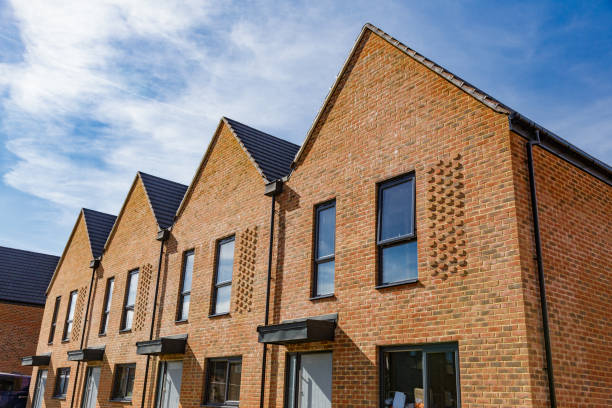
New build properties can be either old, refurbished buildings that have been converted into new homes, such as office buildings, or completely new buildings that did not previously exist. Depending on how big the project is, it could just be two semi-detached new houses in the place of an old demolished one, or a whole new estate that includes new, water and drainage and is privately maintained.
This type of property can be purchased before it is built, as the contract is exchanged on the basis that the construction will be completed to a certain standard and all guarantees, permits and approvals available on completion. It may take several months from exchanging the contracts to completion, depending on the stage of construction and whether some parts of the project may be habitable before other parts are completed
We consider all the features of the new build properties in more detail in Part Two of the book “How to buy your first home in England (and Wales)”.
Housing for the elderly
People in the age group of 50-55 can benefit from specialised types of housing that are designed only for this demographic group.
Because most banks require you to pay off your mortgage by the time you reach retirement age, which is currently around 70-75, it becomes increasingly difficult to be approved for a mortgage when you are over 50 years old. There are however estates which are specifically designed only for the elderly.